Woodland Bridge Plaza: When a Space Becomes a Place
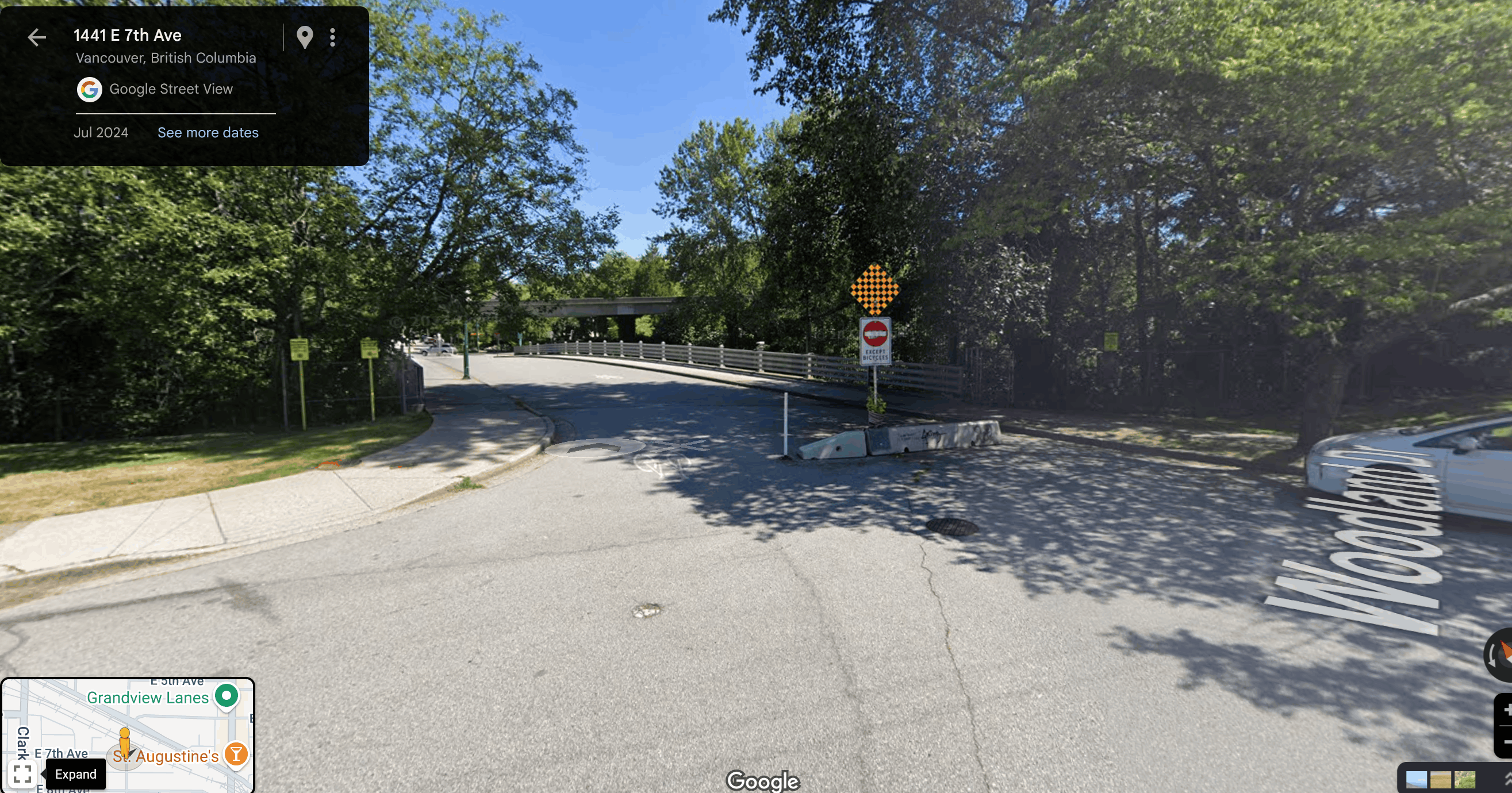
In a neighbourhood in East Vancouver, there was an unassuming bridge that crossed the railroad tracks at the corner of Woodland Drive and East 7th Ave (photo below). The bridge was built in 1991, but from around 2018 until 2025 it was closed to vehicular traffic …at least on paper. Without effective barriers or street markings, locals watched as confused drivers would often drive across the closed bridge.
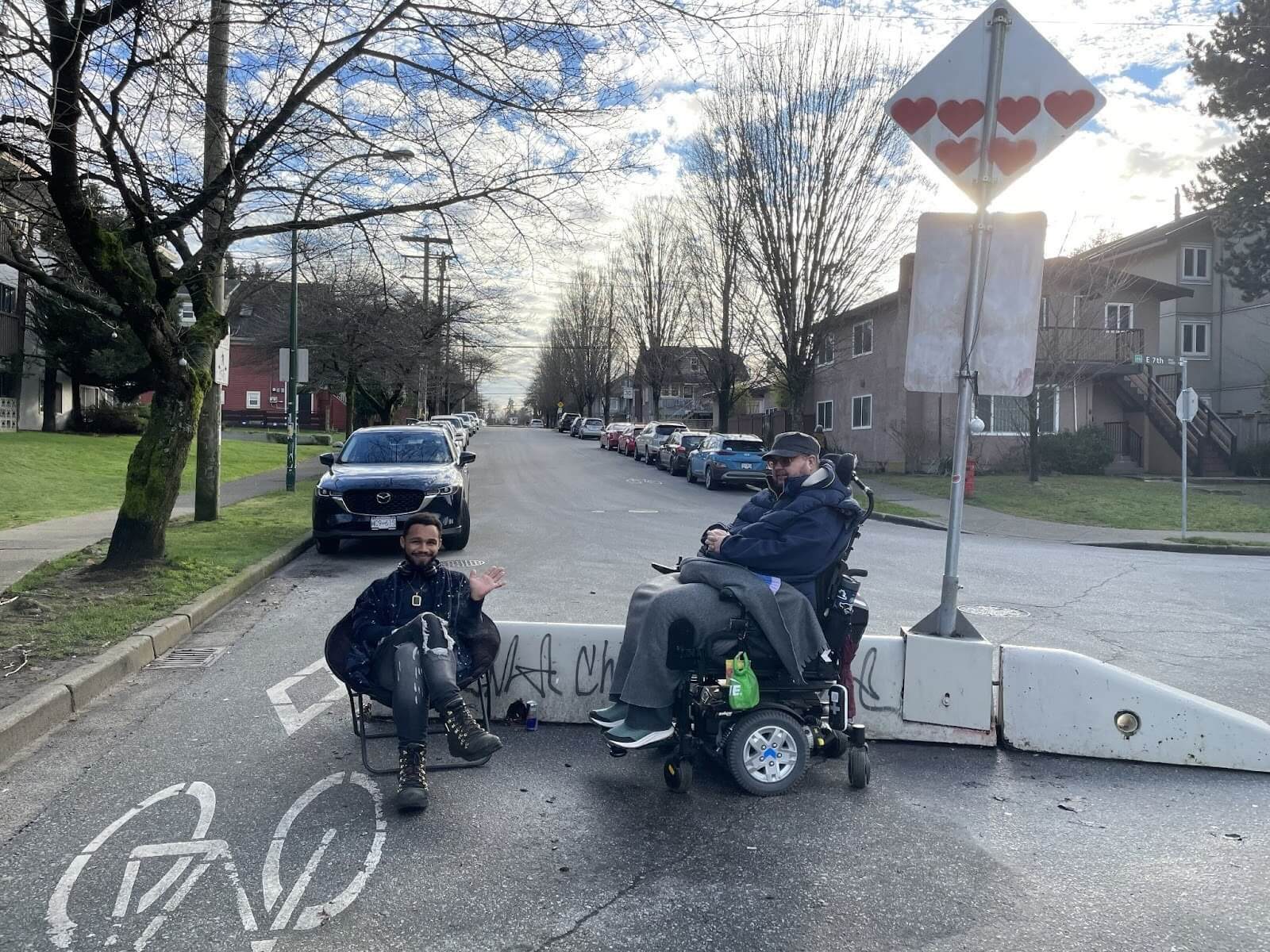
Local residents Tajai and Logan (photo below) started gathering behind one of the barriers installed on the south end of the bridge at the corner of Woodland Drive and East 7th Ave. Since they enjoyed chilling in this new “third space”, they made the first smallest step of creating a modest garden by beautifying it with potted plants (which Tajai personally maintains). Piece by piece, they incrementally augmented the garden into an ad-hoc parklet to include chairs, plants, benches, a small table, a shade pole, etc.
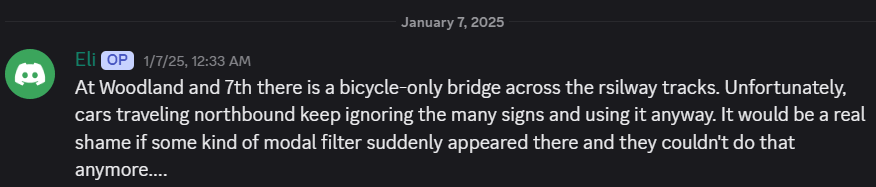
The next smallest step in this street intervention came in Jan 2025 when Eli Carlin-Coleman, the co-founder of Vancouverites-for-People-Oriented-Places (aka, VanPOP, formerly known as Strong Towns Vancouver) planted the tactical urbanism seed in the group’s brain. He posted the following message in the VanPOP Discord channel:
“At Woodland and 7th there is a bicycle-only bridge across the railway tracks. Unfortunately, cars traveling northbound keep ignoring the many signs and using it anyway. It would be a real shame if some kind of modal filter suddenly appeared there and they couldn’t do that anymore….”
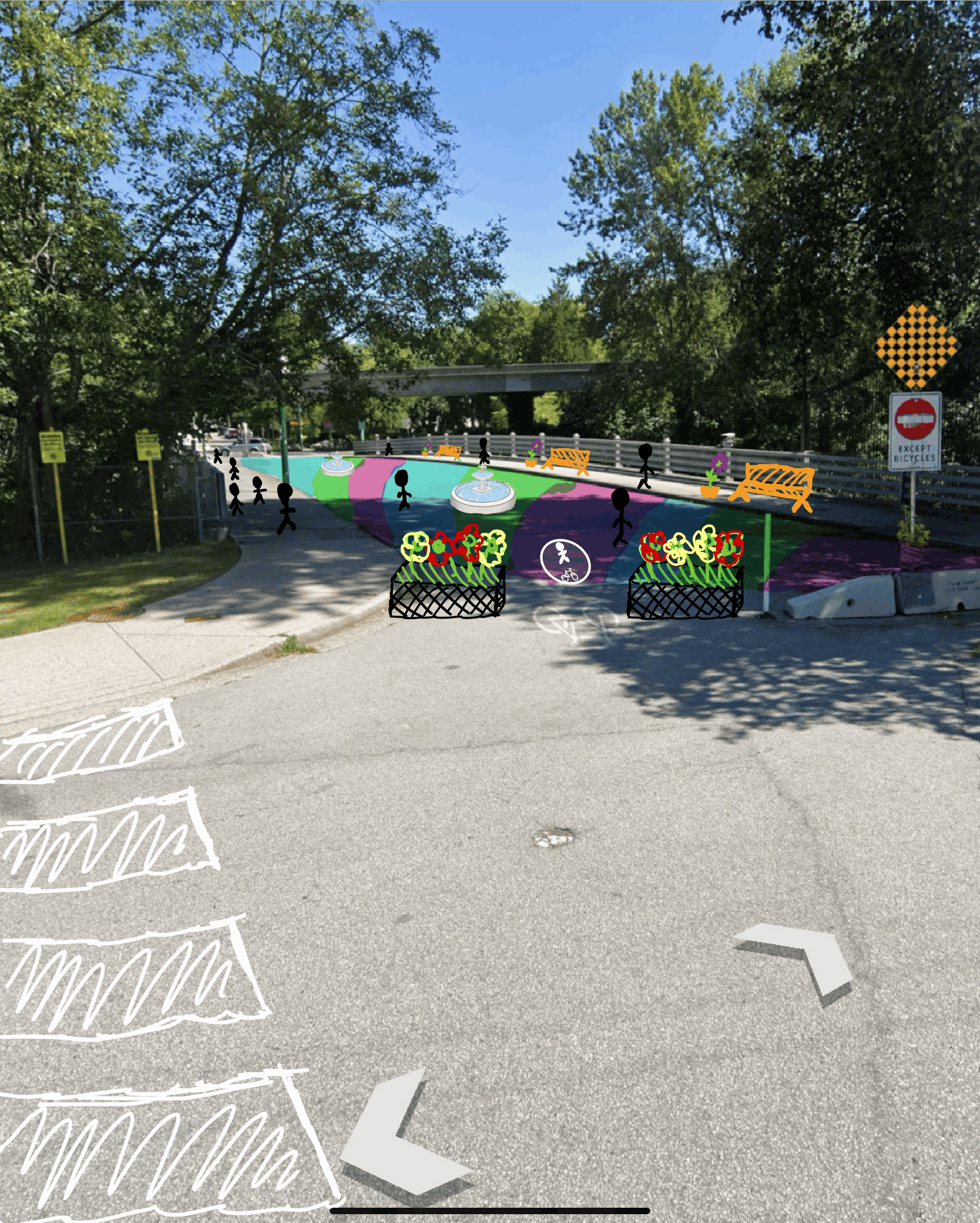
VanPOP’s other co-founder, Kip Santos, immediately supported the idea. Within a couple weeks, many other VanPOP leaders, members, allies, and neighbours posted a flurry of “tactical urbanism” ideas for benches, planters, conflict paint, even an impromptu rendering (photo below) from Khang of the non-profit safe streets advocacy group, Vision Zero Vancouver:
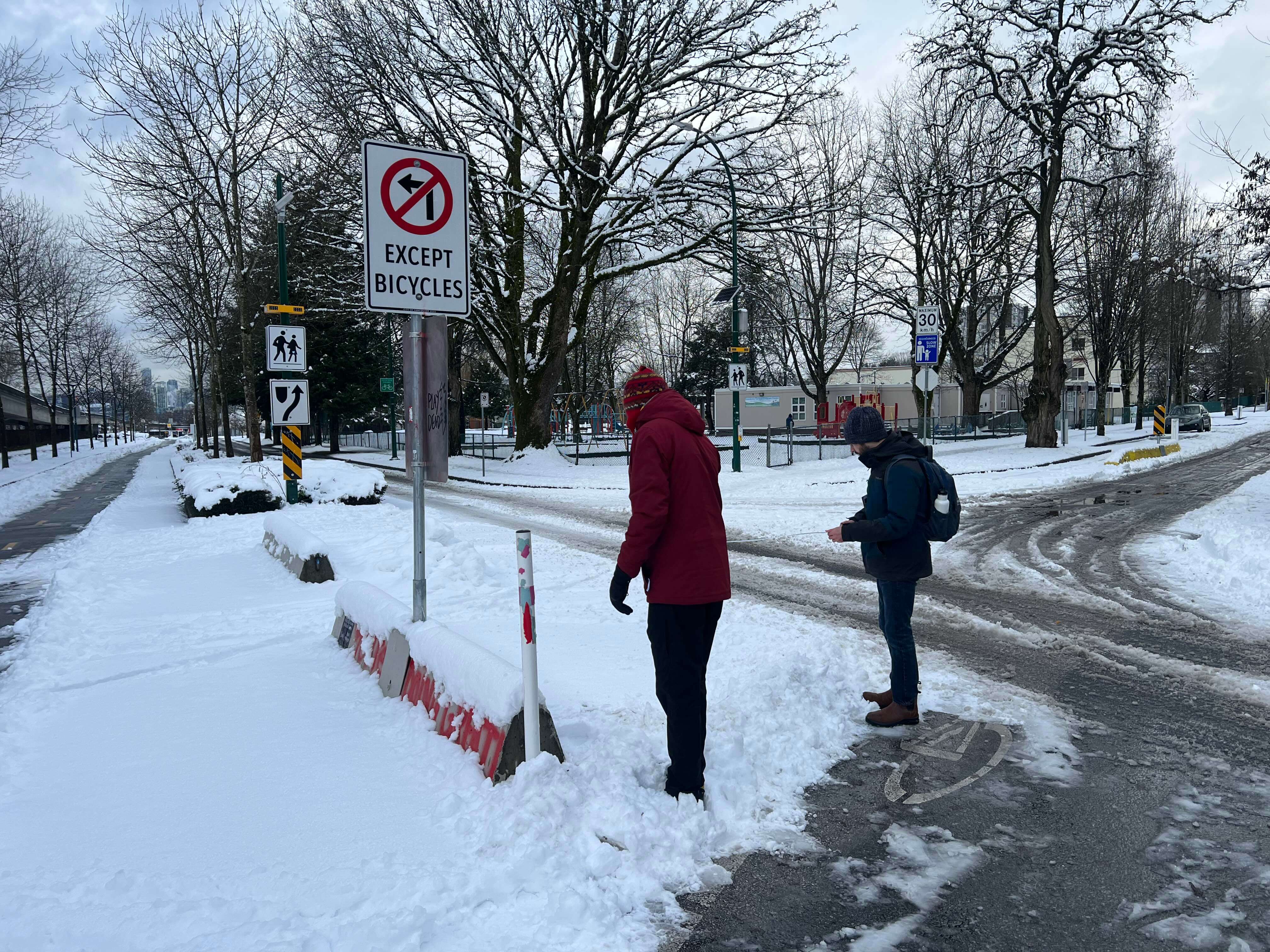
Seeing the potential opportunity and eager for a new project, VanPOP leadership organized the first reconnaissance day in Feb 2025 (photo below) with participation from Vision Zero Vancouver. Occurring on one of the snowiest days of the winter, the cold weather did not deter the group of tactical urbanists. And oddly enough, the desire paths of pedestrians, cyclists, and vehicles were easily seen in the snow which helped VanPOP understand how locals used the bridge in the worst of circumstances. This is when Kip Santos, who participated in the Strong Towns Cohort class of 2024-2025, decided to pitch this tactical urbanism idea to his classmates in order to solicit advice on how VanPOP should proceed. Lots of great feedback!
After Eli and other VanPOP leaders posted flyers with a QR code linked to a survey where locals could suggest improvements they’d like to see on the bridge, the next step was to review that local input and bring as much of it as possible to the tactical urbanism day in early March 2025. The unseasonably sunny and mild weather that Saturday exuded the group’s optimism. Volunteers from VanPOP, Vision Zero Vancouver, and allies brought benches made from pallets, plastic playground items, sidewalk chalk, sign boards, banners, planters, a large picnic table, etc. It was an absolutely wonderful day and the parklet was named, at least temporarily, as “Woodland Bike Bridge” (photos below). I won’t reiterate the highs and lows because one of VanPOP’s leaders, Nav Sharma, already wrote an excellent article about it, so I suggest reading more details here. But to abbreviate, City of Vancouver staff removed and pitched it all, likely for similar reasons as this Strong Towns article about cities shutting down residents (published within a few months).


Soon after the event, Dawson Church, a local resident (and now VanPOP leader), contacted VanPOP about an alliance because he had already been in touch with the City of Vancouver making the case for this same bridge to be adopted by the City of Vancouver’s Neighbourhood Plazas program.
In April 2025, City of Vancouver staff contacted Dawson and VanPOP leadership stating
“I don’t have any concrete updates yet, as we are still having internal discussions about the feasibility of this [plaza/parklet] project. However, staff are broadly supportive of the [plaza/parklet] idea and excited to see the community support behind it. One thing I wanted to check in about was the idea of a ground mural. Are you folks still thinking about a ground mural/street art in the space? And if so, what level of involvement do you see yourselves having (i.e. totally hands off/input on design/organizing the labour and painting etc)?”
This was great news, since this same governmental entity had just tossed all of the temporary fixtures in the garbage within 72 hours of placing it. The removal felt like a huge setback at first, but the survey data VanPOP collected from the community and the overall positive feedback/attention was the extra support the City needed to fully fund this location via the Plazas program.
While Dawson and VanPOP leadership coordinated the future of the Woodland Bike Bridge through the Plazas program, they simultaneously submitted a grant proposal application to another separate and slightly different funding stream, the City of Vancouver’s Community Placemaking Program, which provides local advocacy organizations up to $3,000 for temporary placemaking events and activations during the summer months.
In May 2025, the City of Vancouver contacted Dawson and VanPOP stating,
“It is with great pleasure that we write to inform you that your application to the City of Vancouver’s Community Placemaking Program has been approved. Congratulations! You will receive a funding of $3,000 [CAD] for your proposal, ‘Woodland Bike Bridge pop-up park’ through the Community Placemaking Program. Your application stood out among a competitive pool of candidates, and we believe that your contribution will greatly enrich the city’s public life.”
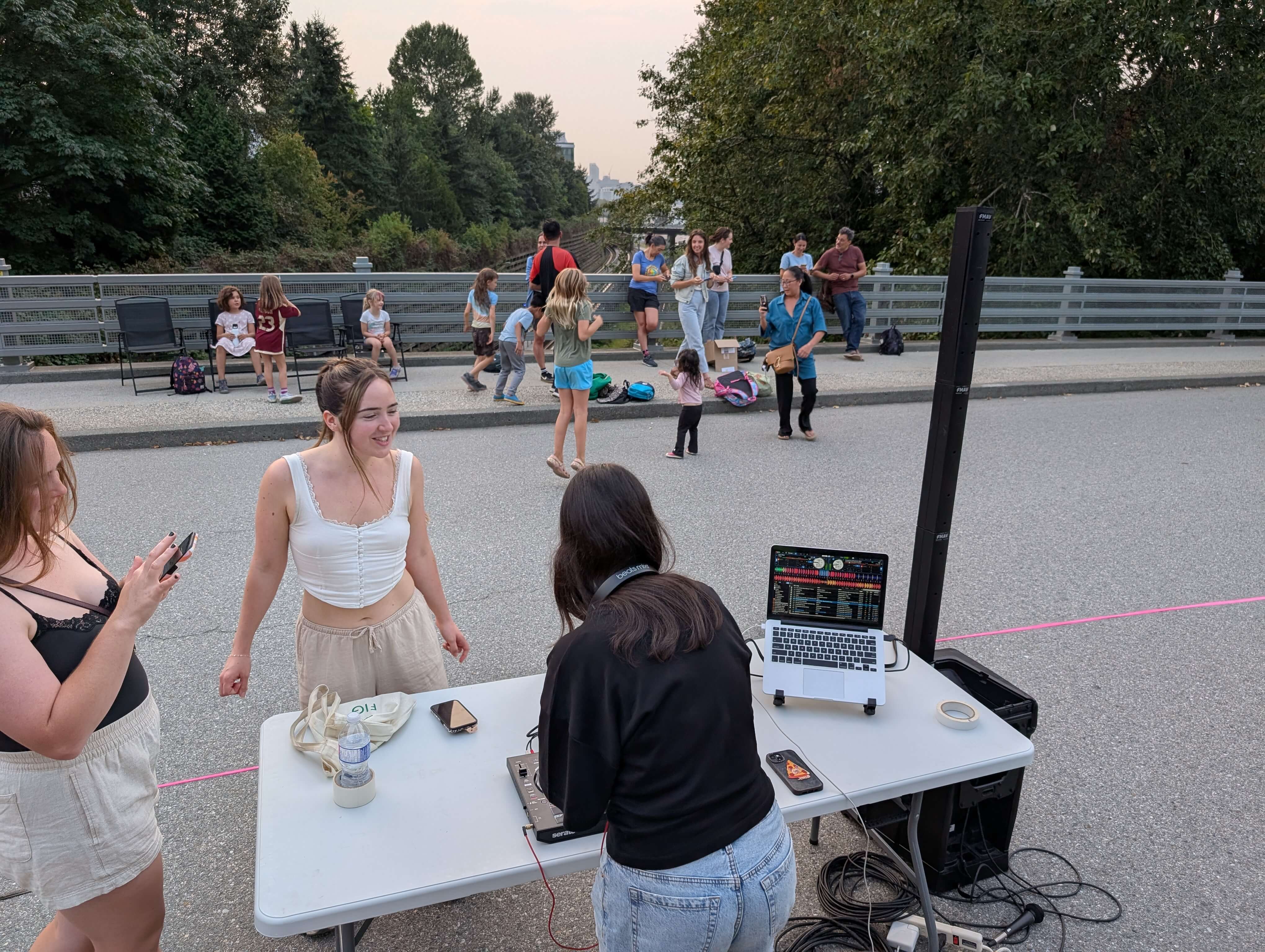
Woohoo, go team! Dawson immediately went to work planning 18 events on the bridge on Tuesdays, Wednesdays, and Thursdays for 6 weeks in September and October. Regardless of weather conditions, he organized each day of the week with chess games, sunset yoga, and mini musical concerts (photo below). Nearly everyone in the neighbourhood enjoyed the street activations so the feedback was overwhelmingly positive.
Nearly, that is, except from a couple vocal opponents. When planning a project which noticeably alters a neighbourhood, it is important to listen to the local residents and to work with them. It is also important to remember that “local residents” are not a monolith. When VanPOP first started hearing concerns they renewed their consultation efforts. What they found was overwhelming support for the project, including from multiple equity-deserving groups.
This is what made it so concerning when VanPOP heard that the City was considering removing the community garden due to the complaint of a single resident. In June 2025, Tajai created an online petition which accumulated 500+ signatures in support of his garden! Funny how the City of Vancouver would consider siding with one anonymous person who wants municipal staff to remove a newly-sprouted community garden even though hundreds of people enjoy it, eh? Luckily the petition worked and the City did not remove the garden. City staff are far more likely to see negative comments than positive feedback, so it is important to ensure positive responses are made as visible as possible.
In September 2025, the City of Vancouver’s Neighbourhood Plazas program stated,
“I wanted to first convey my apologies for the delay on this project – summer can be a busy season for us and this project hit a couple of snags. That being said, we are nearing implementation! My colleagues in Transportation have provided a layout plan that closely mirrors the proposal originally brought forward by all of you. There were some constraints we were working with, mainly limiting vehicle traffic while also ensuring the route is usable by emergency vehicles. But we’ve managed to put the seating on the west side as requested with a delineated bike lane on the east side. I am still working on confirming the exact timeline but will share that and details of the site plan when I’m able to.”
Not necessarily good news, but not bad news either since they had simply delayed, and not cancelled entirely, the bridge project.
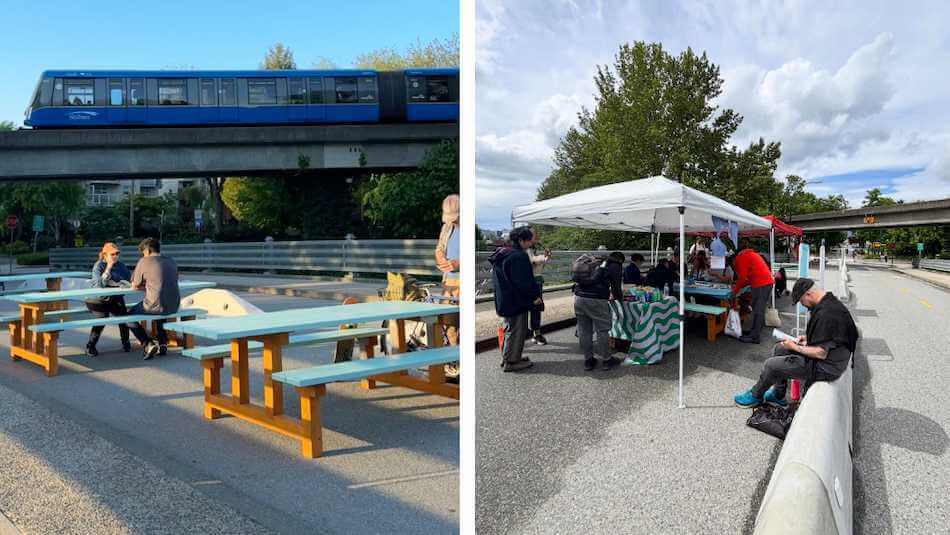
At long last in June 2026 (over one year from VanPOP’s tactical urbanism event), the City of Vancouver finally delivered on its promise to turn the bridge into a neighbourhood plaza by installing picnic benches, barriers, and flexposts (photos below).
Dawson was connected with another local non-profit community art and advocacy group called Community Marks. With the help of VanPOP, Community Marks organized multiple design charrettes in June 2026 with locals to determine what type of asphalt mural they’d like to see on the newly designated plaza, after which they planned a neighbourhood paint day (photos below).
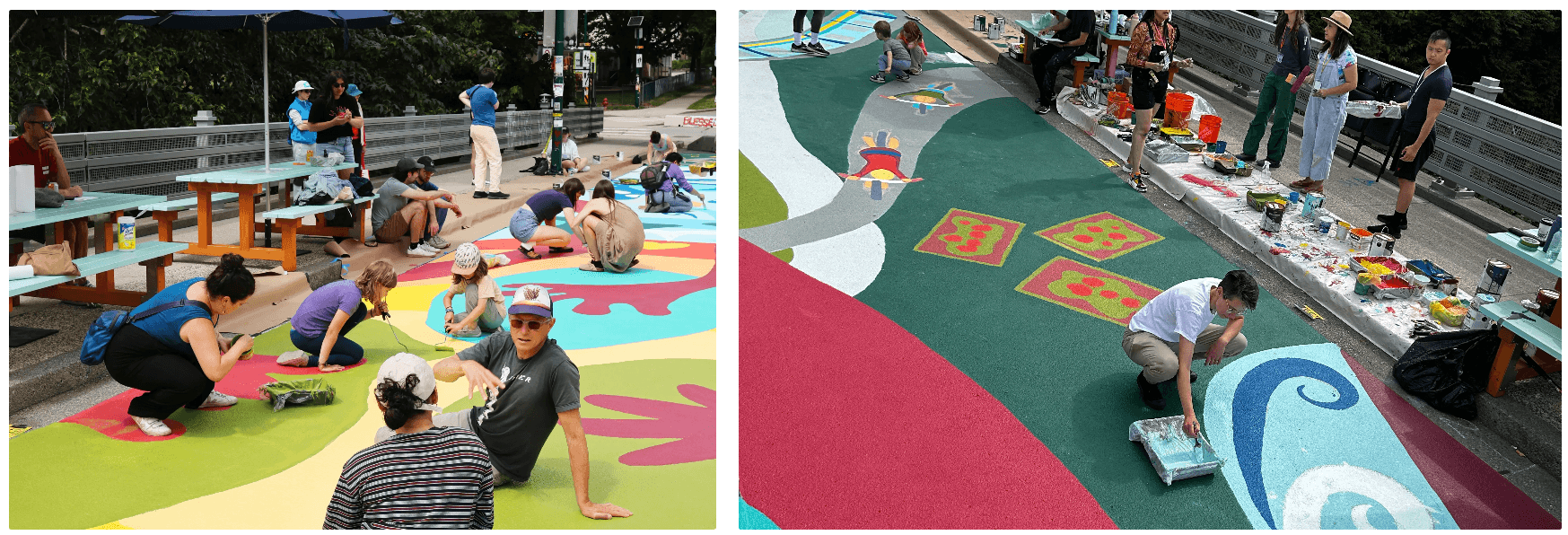
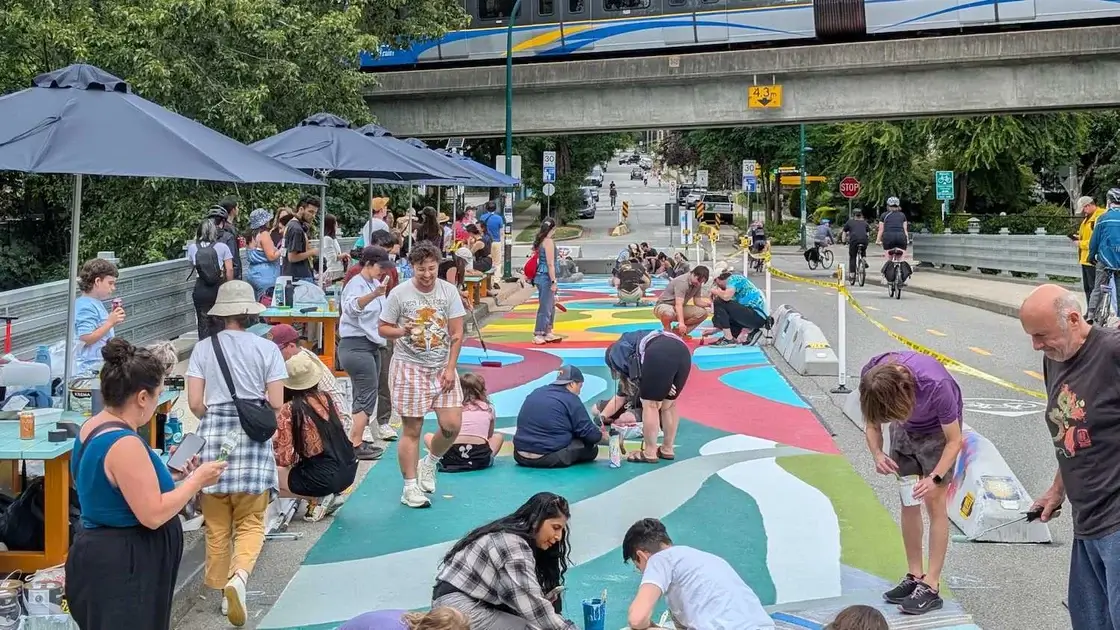
In July 2026 on a sunny Saturday, Community Marks and VanPOP were graced with beautiful weather (again) as 200+ volunteers arrived to help turn the separated plaza area of the bridge into a 50-meter long asphalt mural as the final installment of the Woodland Bridge Plaza (as many folks started calling it). A local resident on Instagram even made a flyover video about it here. Not long after the paint dried, Dawson applied, and was awarded, another $3,000 Community Placemaking grant for more events and activations throughout that summer, which he posted via his Woodland Bridge Plaza Instagram account to gain even more attention and attendance than in 2025.
Nav Sharma wrote another succinct article about this collaborative endeavor in his LinkedIn post stating,
“This used to be a roadway. Now it’s a thriving third space for Grandview-Woodland. On Vancouver’s Woodland Drive bridge over the Grandview Cut, “Road Closed” signs weren’t enough. Cars continuously breached the area, which was intentionally kept accessible to emergency vehicles. A year of brainstorming sessions and scrappy benches built from shipping pallets created a janky little parklet that proved a point. Signage won’t keep the cars away. Placemaking does. Today, the Grandview–Woodland Plaza is an official public plaza set up by the City of Vancouver and stewarded by local residents. A problem became a place.”
Well said.